Safety
Harmattan Driving in Ghana: Dust, Visibility and Safe Car Hire & Rental
Quick answer: The Harmattan in Ghana is the dry, dusty wind from the Sahara that blows during the dry season, roughly from late November to March. It hits the north hardest. The Ghana Meteorological Agency (GMet) has forecast visibility in northern Ghana falling to between 1 km and 6 km during dust surges, and it tells drivers to slow down, use headlights and keep a safe distance. Haze can also delay or cancel domestic flights, especially to Tamale, Kumasi and Wa. If you're hiring a car, ask the firm about working lights, wipers and a driver who knows the route.
This guide is for anyone driving, or being driven, in Ghana between November and March: visitors, business travellers, NGO staff and Ghanaians coming home for Christmas. It sets out what Ghana's weather agency, its road safety authority, its aviation regulator and UK and US travel advice actually say, and what to agree with a car rental and hire firm before a Harmattan trip.
When is the Harmattan in Ghana?
GMet's Ghana Climate Atlas Report 2026 explains that Ghana's seasons are driven by the Inter-Tropical Discontinuity, the boundary between moist south-westerly winds from the Atlantic and dry north-easterly winds from the Sahara. It describes northern Ghana as having stronger exposure to dry continental air during the dry season, December to February.
Other official sources give a slightly wider window:
| Source | What it says about timing |
|---|---|
| GMet Climate Atlas | Dry season in the north is December to February |
| US State Department | Harmattan trade wind blows from the Sahara over West Africa from November to March |
| Ghana Civil Aviation Authority (2019 advisory) | Late November until March, intensifying in January and February |
Dates move from year to year. In the 2025/2026 season, GMet issued a Harmattan alert for the north on 16 November 2025. But Graphic Online reported on 2 January 2026 that GMet described the season's onset as unusually delayed, with many parts of southern Ghana still getting rain in late December, which GMet called "statistically rare for this time of year". GMet expected a generally weak season, with occasional severe dust episodes in the north.
As of 23 October 2026, we couldn't find a GMet outlook for the 2026/2027 Harmattan season. Check GMet's alerts page close to your trip.
How bad does the dust get?
GMet issues Harmattan alerts with forecast visibility. Two from the 2025/2026 season show the range:
| GMet alert | Area | Forecast visibility |
|---|---|---|
| 16–18 November 2025 | Upper East, Upper West, North East, Northern, Savannah | 2,000 m to 6,000 m |
| 17–20 February 2026 | Northern half of Ghana, starting in Upper East and North East | 1 km to 6 km |
The November 2025 alert said dust raised over Chad was being carried into Ghana from northern Benin and Togo by strong low-level winds, with daytime humidity of 20% to 40%. The February 2026 alert warned that afternoon humidity could drop below 10% in parts of the north, and that milder dust could reach the transition zone and middle belt.
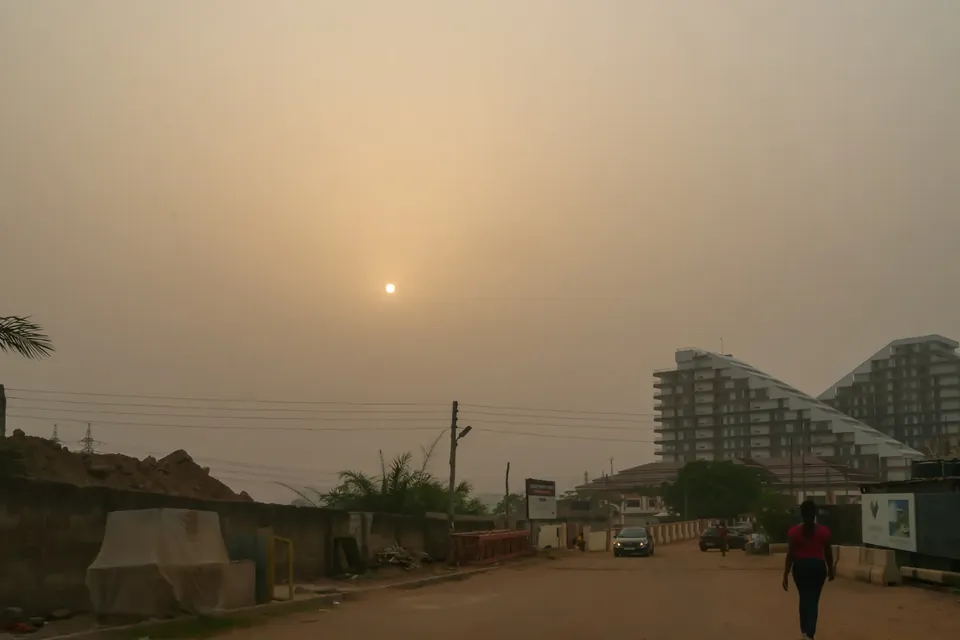
The south usually gets less of it. In its 2025/2026 advisory, as reported by Graphic Online, GMet said visibility in the north would be "relatively lower than those in the south", and that coastal and middle belts were likely to see a milder dry season. The hero photo above was taken in Accra in February 2023, so the haze does reach the capital.
Official advice for driving in Harmattan haze
What GMet says
GMet's alerts tell motorists to exercise extreme caution, reduce speed, use headlights in low visibility and keep safe following distances. Its February 2026 advisory said this matters most in the early morning and late evening. In its 2025/2026 season advisory, GMet also told motorists to use fog lights or headlamps when visibility is reduced, and warned against open-air burning.
What the National Road Safety Authority says
The National Road Safety Authority (NRSA) said in a February 2024 release that dust in the air reduces visibility, "making it difficult for drivers to see other vehicles, pedestrians, and road signs". It advised motorists to:
- slow down and drive with caution, especially where visibility is low
- keep a safe distance from the vehicle in front
- use headlights, and fog lights if necessary
- avoid sudden braking or acceleration
- avoid excessive speed and unnecessary overtaking
- keep windows and mirrors clean
- use the right edge of the road as a guide
- watch for traffic and construction signs
- if the vehicle breaks down, place advance warning triangles not less than 45 metres away
The NRSA also asked pedestrians to wear bright or reflective clothing. In December 2022, the NRSA's public relations officer told Citi News that drivers should check their lights, keep them on when it's hazy, and make sure the windscreen is clean and the wiper working. In haze, expect people walking on the roadside to be harder to see.
After dark
The UK FCDO already advises avoiding road travel outside the main towns after dark, because street lighting is poor or non-existent and the risk of serious accidents is much greater. Harmattan haze adds to that, and GMet and the NRSA both single out dawn and dusk. On a long journey north, plan to arrive in daylight. Our guide to whether it's safe to drive in Ghana covers the wider road-safety advice.
Harmattan and flights to the north
If you're flying to Tamale, Kumasi or Wa between December and February, have a back-up plan.
In a December 2019 advisory reported by MyJoyOnline, the Ghana Civil Aviation Authority (GCAA) warned that poor Harmattan visibility could, in extreme cases, lead to flight delays, diversions and cancellations when visibility falls below operating limits. It said the effect is expected to be more severe at Kumasi, Tamale and Wa airports.
It has happened before. In December 2015, Graphic Online reported that domestic airlines suspended flights in hazy Harmattan weather, and that Tamale Airport's manager said visibility had dropped from 3,000–4,000 metres to 400–800 metres. Graphic reported that some stranded passengers switched to road transport, while international flights at Accra International Airport (formerly Kotoka) kept operating. Graphic also reported Tamale flights cancelled for several days in January 2015 for the same reason.
The US State Department says Harmattan winds reduce visibility, cause breathing problems and affect air travel.
What this means for car hire & rental:
- If you've booked a car to meet a domestic flight, give the firm your flight number and agree what happens if the flight is delayed, diverted or cancelled.
- If flights are grounded, driving north is an option, but it's a long day. Our Accra to Tamale by road guide covers the route and timings.
- If you're collecting a car on arrival, check our airports page for the airport you're flying into.
What to ask your car hire & rental firm
Ask these questions in writing before you book a trip in the Harmattan season:
| Ask about | Why it matters |
|---|---|
| Headlights, fog lights (if fitted) and hazard lights all working | GMet and the NRSA both tell drivers to use lights in haze |
| Wipers working and a clean windscreen | The NRSA says to keep windows and mirrors clean, and its spokesperson has said the wiper should be working |
| Warning triangles in the boot | The NRSA says to place them at least 45 m away after a breakdown |
| Whether a driver can be added | Some visitors prefer not to self-drive in poor visibility |
| What happens if a domestic flight is cancelled and you need the car sooner, later or elsewhere | Agree it before, not after |
| A 24-hour phone line | Problems don't keep office hours |
If you're starting in the north, compare firms on our car hire & rental in Tamale page.
Health and comfort
GMet's alerts advise drinking plenty of water, wearing a nose mask or face covering in dense dust, and using moisturiser for dry skin. People with asthma or other breathing conditions should keep their medication to hand and limit time outdoors. The US State Department says air quality in Ghana is typically at its worst in the Harmattan season. Nights in the north can also feel cooler, so GMet suggests keeping warm clothes handy.
A short Harmattan checklist
- Check GMet's alerts on the morning you travel.
- Check that the headlights and wipers work before you set off.
- Drive slower and leave a bigger gap in haze.
- Avoid driving outside towns after dark, and take extra care at dawn and dusk.
- Carry water, a face mask and any medication you need.
- If you're flying north, keep the firm updated on your flight.
Frequently asked questions
When is the Harmattan season in Ghana?
Roughly from late November to March. The US State Department gives November to March, the Ghana Civil Aviation Authority has described late November until March with the worst in January and February, and GMet's Climate Atlas puts the north's dry season at December to February. Timing varies each year.
Is it safe to drive in Ghana during the Harmattan?
Yes, with care. GMet and the National Road Safety Authority advise slowing down, using headlights, keeping a safe distance and avoiding unnecessary overtaking, especially in the early morning and late evening when visibility is worst.
Which parts of Ghana are worst affected?
The north. GMet's alerts in the 2025/2026 season focused on the Upper East, Upper West, North East, Northern and Savannah regions, and GMet said visibility in the north would be lower than in the south.
How low can visibility get in the Harmattan?
GMet forecast visibility of 1 km to 6 km in northern Ghana during a February 2026 dust surge. In December 2015, Graphic Online reported visibility of 400 to 800 metres at Tamale Airport.
Does the Harmattan affect flights in Ghana?
It can. The Ghana Civil Aviation Authority has warned of possible delays, diversions and cancellations when visibility is too low, especially at Kumasi, Tamale and Wa. Domestic flights were suspended in severe Harmattan in 2015.
Should I use headlights in the Harmattan?
Yes. GMet and the National Road Safety Authority both tell drivers to use headlights in low visibility, and fog lights if the car has them.
Next steps
Compare firms on our search page and ask each one the same Harmattan questions about lights, wipers, drivers and flight changes. Pick the firm that answers clearly and in writing, and check each firm's own page for its prices.
Sources
- Ghana Climate Atlas Report 2026: dry north-easterly winds from the Sahara and the December to February dry season (PDF, checked 23 October 2026) (Ghana Meteorological Agency (GMet))
- Harmattan Alert: Dusty Conditions and Reduced Visibility Expected Across Northern Ghana (issued 16 November 2025) (Ghana Meteorological Agency (GMet))
- Harmattan Advisory: Dry and Dusty Weather Expected over Northern Ghana (issued 16 February 2026) (Ghana Meteorological Agency (GMet))
- Unusual rains delay harmattan: Ghana braces for milder dry season (GMet 2025/2026 Harmattan advisory; 2 January 2026) (Graphic Online)
- Dry season and road safety: a call to action for motorists and pedestrians (7 February 2024, checked 23 October 2026) (National Road Safety Authority (NRSA))
- Harmattan: Drivers asked to take precautions to minimise risks of crash (8 February 2024) (Ghana News Agency)
- Harmattan is here; drive with caution – Road Safety Authority (24 December 2022) (Citi Newsroom)
- Expect flight cancellation as Harmattan approaches – GCAA to customers (23 December 2019) (MyJoyOnline)
- Harmattan grounds domestic airlines (7 December 2015) (Graphic Online)
- Ghana country information: weather conditions and air quality (Harmattan, November to March) (checked 23 October 2026) (US Department of State)
- Ghana travel advice: safety and security (road travel after dark) (checked 23 October 2026) (UK FCDO)
Last checked: 23 October 2026. Rules, prices and advice change, so recheck official sources before you travel.
Related guides
Driving in Ghana in the Rainy Season: Flooded Roads and Car Hire & Rental Tips
Rainy season in Ghana: the months in the south and north, where roads flood, official flood alerts, when a 4x4 helps and what to ask a car hire & rental firm.
Photo: Fquasie, CC BY-SA 4.0