Safety
Driving in Ghana in the Rainy Season: Flooded Roads and Car Hire & Rental Tips
Quick answer: The rainy season in Ghana depends on where you are. The Ghana Meteorological Agency (GMet) says the south has two rainy seasons, a major one from March to July and a minor one from September to November, with a drier spell in August. The north has one rainy season, typically from about April to October. Heavy rain can flood roads quickly, including in Accra. Check GMet and NADMO alerts, never drive into floodwater, and ask your car hire & rental firm about routes and breakdown cover before you set off.
This guide is for anyone driving or being driven in Ghana between March and November: visitors, business travellers, NGO staff, students and Ghanaians coming home. It sets out what Ghana's weather agency, its disaster agency and UK and US travel advice actually say, and what to agree with a car rental and hire firm before a wet-season trip.
When is the rainy season in Ghana?
GMet's Ghana Climate Atlas Report 2026 explains that rainfall follows the seasonal movement of the Inter-Tropical Discontinuity, so the south and the north have different patterns.
| Area | Rainy season (GMet) | Notes |
|---|---|---|
| Southern Ghana (south of 8°N) | Major: March to July. Minor: September to November | Rain eases in August, the "little dry season" |
| Northern Ghana (north of 8°N) | One season, typically from around April to October | GMet lists December to February as the dry season |
GMet says Ghana lies roughly between latitudes 4.5°N and 11.5°N, so the 8°N line falls around the middle of the country. Accra, Kumasi, Cape Coast and Takoradi are in the southern pattern. Tamale, Bolgatanga and Wa are in the northern one.
These are typical patterns, not fixed dates. Onset and end vary from year to year, so check the forecast close to your trip.
Other sources put it slightly differently. The US State Department describes Ghana's wet season as April to October and its dry season as November to March. The UK FCDO says flooding is common in the north during the rainy season from March to November.
Where roads flood
Accra and the south
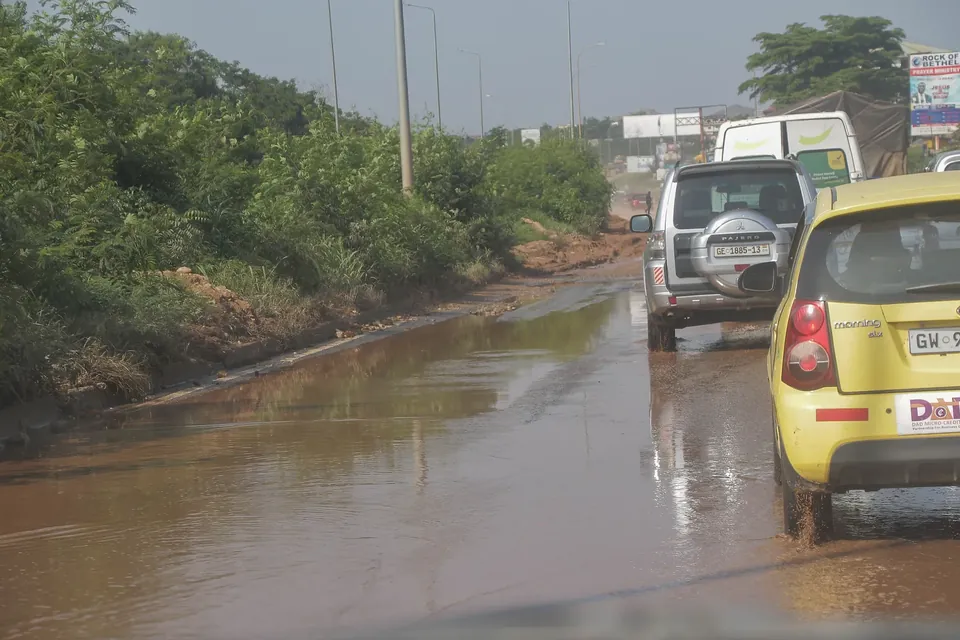
The UK FCDO says heavy rainfall can cause flooding in urban areas such as Accra and its surroundings, that flooding can disrupt road travel and public transport, and that conditions can change quickly after intense rain. The US State Department says Accra and other major cities often flood during the rainy season.
On 29 June 2026 this happened on a large scale. The Ghana News Agency reported that:
- the Weija–Kasoa road was completely blocked by floodwater
- sections of the N1 highway were heavily submerged
- the Atomic Roundabout was flooded and impassable
- the Legon–GIMPA bypass was blocked near the new Law School building
- the stretch from the Ghana Standards Authority to Shiashie was down to one lane
Citi Newsroom listed further affected areas the same morning, including Apenkwa towards Tesano, Mallam, Achimota, Spintex, Kaneshie, Darkuman Junction and parts of the Kwame Nkrumah Interchange. It noted that Accra floods repeatedly during heavy rain, with poor drainage, waste disposal and rapid urbanisation widely cited as causes.
For an airport run, allow extra time on wet days. If you're collecting a car at Accra International Airport (formerly Kotoka) during heavy rain, ask the firm which route its driver will take.
Northern Ghana
The FCDO says flooding is common in the Upper West, North East, Northern and Savannah regions during the rainy season, from March to November. The US State Department adds that rural areas may flood from rivers, and that secondary roads and many roads outside major cities are mostly in poor condition.
River flooding can also come from upstream. In August 2026, Graphic Online reported that farmers along the White Volta in the North East Region were bracing for possible flooding as Burkina Faso's Bagré Dam neared the level at which its spillway gates could open. NADMO's North East regional director advised communities downstream of the White and Black Volta to move to higher ground.
If you're heading north, read our guide to the Kumasi to Tamale road for the route and safety advice.
Official flood and weather alerts
Two Ghanaian agencies publish the alerts that matter:
- GMet posts weather warnings on its alerts page, with a severity level and the regions affected. On 21 October 2026 it listed a warning of thunderstorms approaching coastal Ghana, and earlier October warnings for thunderstorms and rainstorms over the northern and transition areas. GMet also publishes 24-hour, weekly and weekend impact-based forecasts.
- NADMO (the National Disaster Management Organisation) posts alerts on its website, such as a flood warning for the northern part of Ghana in June 2026, and lists 112 as its emergency hotline.
The FCDO's advice is to follow local authorities, monitor local weather reports and expect difficulties when travelling to affected areas.
Never drive into floodwater
During the June 2026 Accra floods, the Ghana News Agency reported that NADMO cautioned the public never to walk, swim or drive through floodwaters, warning that moving water can be deeper and more dangerous than it looks. NADMO also stressed that floods can happen without warning, and told people to call 112 in an emergency.
In practice, for a hire or rental car:
- If the road ahead is under water, turn round and find another route, or wait for it to drain.
- Don't follow other vehicles in. A taxi or lorry getting through doesn't mean your car will.
- Leave more distance in heavy rain, and use dipped headlights.
- Avoid driving outside the main towns after dark. The FCDO says the risk of serious road accidents is much greater then, and street lighting is poor or non-existent.
If something goes wrong, our guide to what to do after a car accident in a hire or rental car lists the emergency numbers and steps. Our guide to whether it's safe to drive in Ghana covers the wider road-safety advice.
When to choose a 4x4
A 4x4 or high-clearance vehicle is worth considering in the rainy season if you're:
- heading north, to Mole National Park or onto unpaved roads
- driving rural or secondary roads, which the US State Department says are mostly in poor condition
- carrying heavy loads or a full group
For city driving and the main paved highways, a standard car may be enough; ask the firm what it recommends for your route and dates. Whatever you drive, a 4x4 doesn't make floodwater safe; NADMO's advice applies to every vehicle. Our guide to 4x4 car hire & rental for Mole and northern Ghana covers vehicle choice for the north.
What to ask your car hire & rental firm
Ask these questions in writing before you book a rainy-season trip:
| Ask about | Why it matters |
|---|---|
| The route the firm recommends, and any roads it avoids after heavy rain | Local drivers know which stretches flood |
| Breakdown and recovery: who comes, and how far it covers | Recovery is harder on rural roads |
| A 24-hour phone line | Floods and breakdowns don't keep office hours |
| Which insurance cover the car has | See below |
| Whether a driver can be added | Some visitors prefer not to self-drive in heavy rain |
| What happens if you can't return the car on time because of flooding | Agree it before, not after |
On insurance, the National Insurance Commission says third-party liability cover is legally mandatory, but it only covers injury or damage to others. It describes comprehensive cover as also covering damage to your own vehicle, theft, fire and natural disasters. The NIC adds that specific terms vary by insurer, so ask the firm what the car's policy covers and what you would owe if it were damaged by water.
If you plan to drive yourself, see our page on self-drive car rental in Ghana.
A short rainy-season checklist
- Check GMet's alerts and forecast on the morning you travel.
- Save 112, plus the firm's 24-hour number.
- Plan to arrive before dark, and allow extra time on wet days.
- Keep your phone charged; the FCDO says flooding can disrupt electricity.
- Carry water and snacks in case a road is closed and you have to wait.
- Never drive into floodwater.
Frequently asked questions
What months is the rainy season in Ghana?
In the south, GMet says the major rainy season typically runs from March to July and the minor one from September to November, with a drier spell in August. In the north there is one rainy season, typically from around April to October.
Does northern Ghana have one rainy season?
Yes. GMet says the northern sector (north of 8°N) has a single rainy season that typically begins around April and lasts until October. The south has two.
Is it safe to drive in Ghana in the rainy season?
You can, with care. The UK FCDO says flooding can disrupt road travel, including in Accra, and conditions can change quickly after intense rain. Check GMet and NADMO alerts, avoid driving outside towns after dark, and never drive into floodwater.
Does Accra flood?
Yes. The FCDO and the US State Department both say Accra can flood in heavy rain. On 29 June 2026 the Ghana News Agency reported the Weija–Kasoa road blocked and sections of the N1 submerged.
Do I need a 4x4 in the rainy season?
Not for most city and highway driving. A 4x4 or high-clearance vehicle helps on rural and unpaved roads, especially in the north, but no vehicle makes floodwater safe to drive through.
Where can I get flood warnings in Ghana?
GMet publishes weather warnings on its alerts page, and NADMO publishes alerts on its website. NADMO's emergency hotline is 112.
Next steps
Compare firms on our search page and ask each one the same rainy-season questions about routes, breakdown cover and insurance. Pick the firm that answers clearly and in writing, and check each firm's own page for its prices.
Sources
- Ghana Climate Atlas Report 2026: rainfall patterns in the south (two rainy seasons) and the north (one rainy season) (PDF, checked 22 October 2026) (Ghana Meteorological Agency (GMet))
- Alerts: weather warnings for Ghana (checked 22 October 2026) (Ghana Meteorological Agency (GMet))
- NADMO: latest alerts and emergency hotline 112 (checked 22 October 2026) (National Disaster Management Organisation (NADMO))
- Ghana travel advice: safety and security (road travel, flooding March to November) (checked 22 October 2026) (UK FCDO)
- Ghana country information: road conditions and weather (checked 22 October 2026) (US Department of State)
- Greater Accra floods trap residents, cut roads off, public vigilance urged (29 June 2026) (Ghana News Agency)
- Heavy rains flood parts of Accra, disrupt morning commute (29 June 2026) (Citi Newsroom)
- Bagre Dam spillage looms: NADMO triggers emergency response strategy (29 August 2026) (Graphic Online)
- Insurance products: motor insurance types (checked 22 October 2026) (National Insurance Commission (NIC))
Last checked: 22 October 2026. Rules, prices and advice change, so recheck official sources before you travel.
Related guides
Harmattan Driving in Ghana: Dust, Visibility and Safe Car Hire & Rental
Harmattan in Ghana: when the dusty season runs, how haze cuts visibility, official GMet and NRSA driving advice, flight disruption and car hire & rental tips.
Photo: Matti Blume, CC BY-SA 4.0